Nine programmes, one standard, two campuses: every course runs in Nakuru and in Kisumu, hands-on from day one. From a one-day AHA BLS provider course to the ten-month EMT diploma with 500 hours of field and hospital internship.
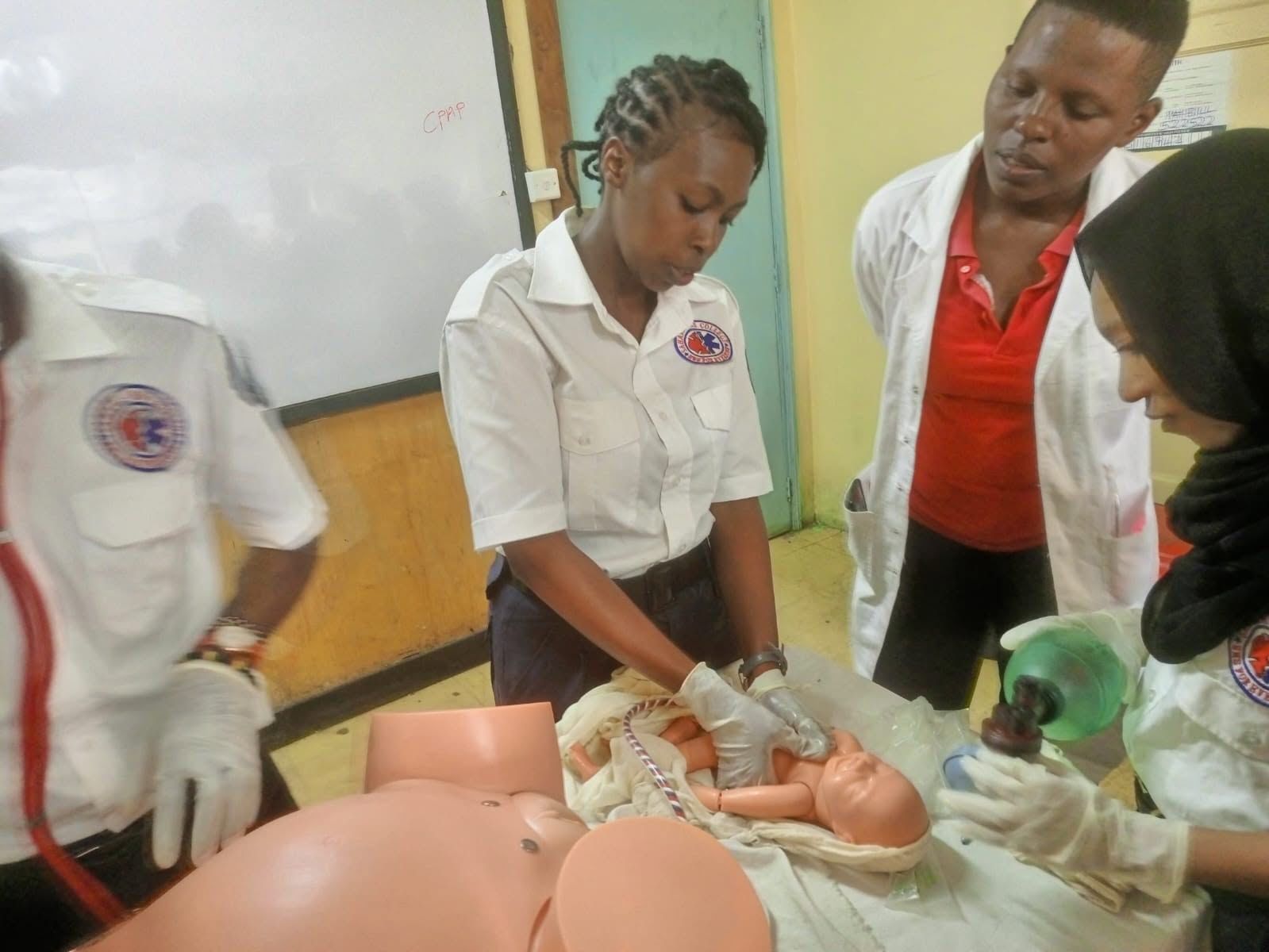
School leavers and health workers who want to work on an ambulance. Start with the EMT diploma — or with EMR if you need the bridging course first.
EMT diploma →Nurses, clinical officers and doctors who need current resuscitation certificates: AHA BLS first, then AHA ACLS or AHA PALS. ECG Basic and the Airway + Breathing Masterclass deepen specific skills.
AHA BLS · AHA ACLS · AHA PALS →Factories, schools, hotels, offices and sites that need certified first-aiders and fire marshals. We come to you.
First aid and fire →The EMT course is our flagship programme and gives you an exceptional foundation in pre-hospital emergency medicine. It combines classroom teaching with hands-on skills work — an intensive minimum of 24 hours a week for 22 weeks of didactics, followed by at least 500 hours of internship as a practising EMT under a field preceptor and in hospital clinical rotations. The whole programme is completed in 10–12 months. Our instructors bring more than 20 years of pre-hospital patient care and teaching into every class.
School leavers who want a career in pre-hospital care, and health workers who want to move into emergency response. Admission is competitive and applications close 5 December.
The Emergency Medical Responder course is the basic EMS course and the entry point for anyone who wants to work in emergency medical services. In three weeks you learn to recognise an emergency, keep a patient alive and hand over to the ambulance crew — the skills that make the difference in the first minutes. The full course costs KES 22,500.
Hospital support staff, ambulance and matatu drivers, security teams, community health volunteers — and anyone who wants to be the first one there.
High-quality CPR, AED use and relief of choking for adults, children and infants — taught to the current resuscitation guidelines with manikin feedback and team scenarios.
One day of instructor-led practice on feedback manikins, followed by a skills test and written exam. Successful candidates receive an AHA BLS provider card valid for two years. AHA BLS is the prerequisite for AHA ACLS and AHA PALS.
Nurses, clinical officers, doctors, dentists and students in the health professions. AHA BLS is the prerequisite for AHA ACLS.
Team-based resuscitation for clinicians: rhythm recognition, airway and vascular access, pharmacology and post-cardiac-arrest care, practised in simulated code scenarios.
Doctors, clinical officers, nurses, anaesthetists and other clinicians who lead or take part in the management of cardiac arrest and other cardiovascular emergencies — in emergency departments, ICUs, theatres and critical-care transport.
Two days: pre-course self-assessment, high-performance team simulations in megacode scenarios, then a skills test and written exam. AHA ACLS provider card valid for two years. A current AHA BLS certificate is required to enrol.
Systematic assessment and management of critically ill infants and children: recognising respiratory distress and failure, shock and cardiac arrest early, and acting as a high-performance team. Practised in simulated paediatric scenarios with manikin feedback.
Paediatricians, doctors, nurses and clinical officers in emergency departments, paediatric wards, neonatal and intensive care, and EMTs who transport children.
An interactive two-day course that turns the rhythm strip into clinical decisions. Participants work through the pre-course manual before the course and start day one with a short knowledge check. Short focused talks clear up open questions and lead straight into plenty of hands-on practice — skills stations, a gallery walk of real ECGs and scenarios on the corpuls3 monitor-defibrillator.
EMTs, paramedics, nurses and doctors who monitor patients and want to read rhythms with confidence — and a strong preparation for AHA ACLS.
The A+B format was created by the RESQPool Academy in 2023 to close the skills gap in airway and breathing management — more than 1,000 participants have trained in it since. The masterclass combines the A+B Basic and A+B Advanced levels into one four-day course: prepare with the English pre-course manual, then work hands-on from the first hour. The certificate has no expiry date; we recommend a one-day refresher every year, especially for skills you do not use daily.
EMTs, paramedics, nurses and doctors who manage airways and ventilation — in the field, the emergency department or intensive care.
Practical first aid for staff teams: CPR and AED, bleeding, burns, fractures, medical emergencies and the first-aid kit — built around the risks of your workplace.
Two days, on your premises or at the college, for groups of 8–20. The programme is adapted to the hazards of your workplace, and every participant receives a certificate. Sahara EMS College is a NITA-approved trainer.
Factories, schools, hotels, offices, farms and construction sites that need trained first-aiders on every shift.
Fire prevention, extinguisher drills with live fire, evacuation procedures and the duties of a fire marshal — so your team knows exactly what to do before the fire brigade arrives. We also run advanced fire courses for safety teams that need more than the basics.
Workplace safety teams and fire marshals. Often combined with First Aid at Work as a three-day safety week.
Admissions will talk you through the options, dates and fees — by phone, WhatsApp or in person at our Nakuru or Kisumu campus.