
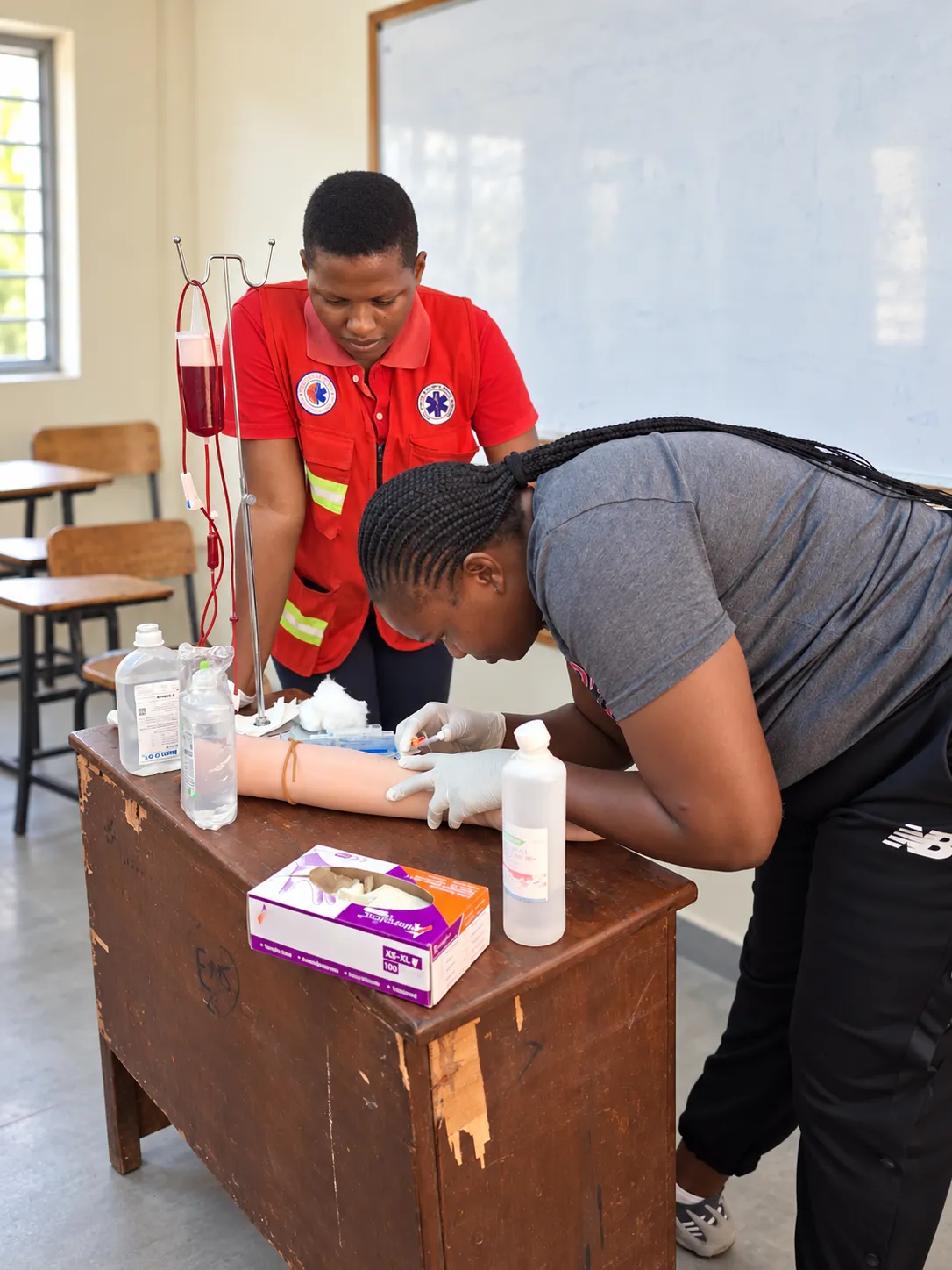
A two-year-old is carried into a county hospital casualty department after three days of diarrhoea. She is cold, her eyes are sunken and she barely reacts. The nurse has tried twice for a cannula. The protocol is clear about what the child needs: fluids at the right rate, glucose, perhaps blood. What it cannot give her is a vein.
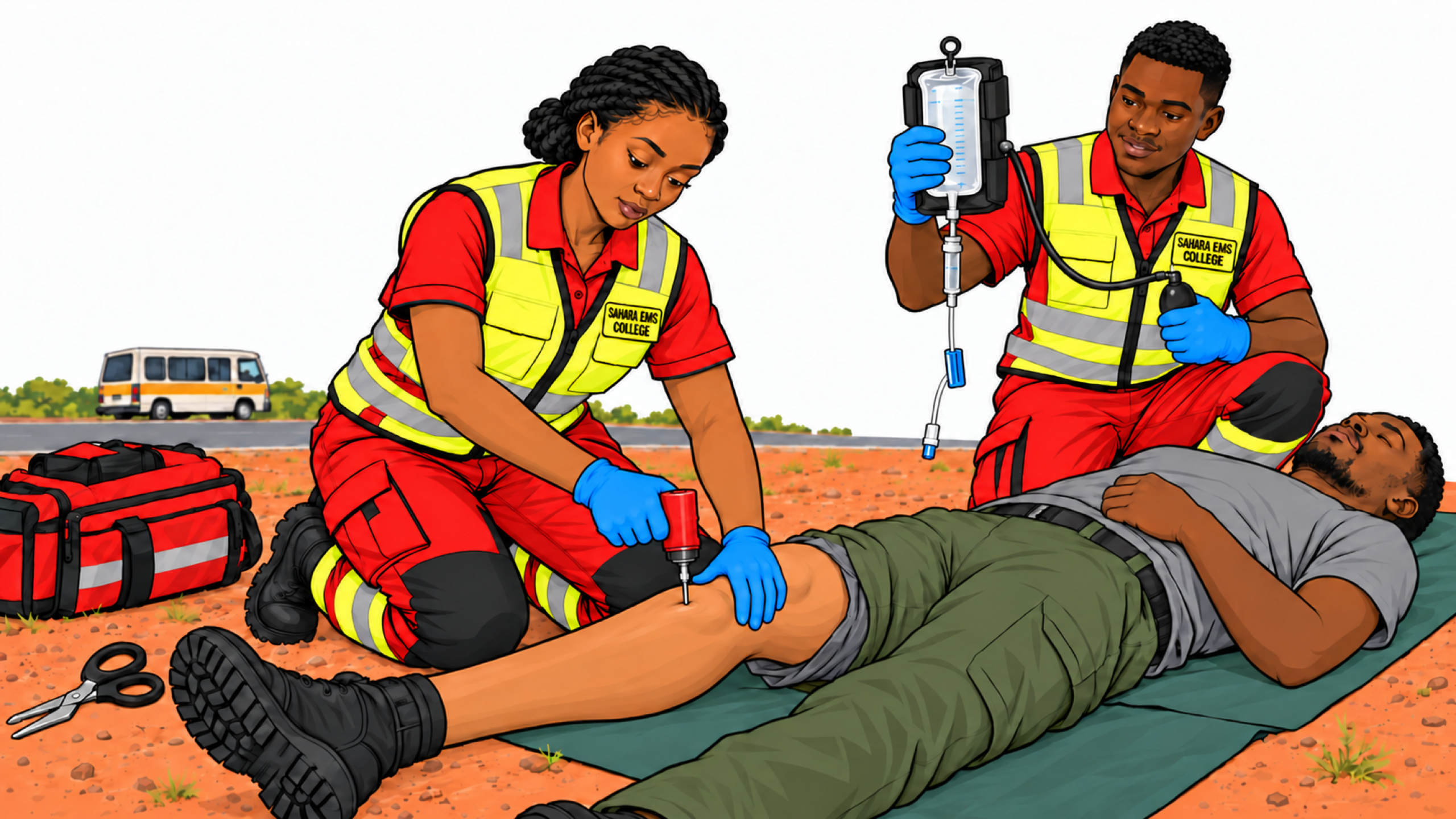
Every emergency provider in Kenya knows this moment. In a shocked, dehydrated or arrested patient the veins collapse exactly when they are needed most. Intraosseous (IO) access is the answer that resuscitation medicine has used for decades: a needle placed into the marrow cavity of a long bone, usually just below the knee. The marrow drains straight into the central circulation and, unlike a vein, it does not collapse when the patient does.
Today we publish a whitepaper on intraosseous access in prehospital emergency care, written from a Kenyan perspective. It brings together the current evidence, the 2025 guidelines, the devices on the market, police and military use, and what it would take to make IO a routine, well-governed skill on Kenyan ambulances. You can download it free of charge at the end of this article.
A vein inside the bone
Every resuscitation drug, every fluid and every blood product that can be given into a vein can be given into the bone, at the same dose. Drugs reach the central circulation quickly. Two practical rules make the difference: fluids need pressure (a pressure bag or a syringe, not gravity), and a 5–10 mL saline flush straight after insertion is the single most important step for flow. In a conscious patient, lidocaine through the needle before the flush makes the infusion tolerable.
The usual site is the flat inner surface of the shin bone, two finger-breadths below the knee. In adults who need large volumes, the top of the upper arm gives roughly twice the flow. Purpose-built sternal devices are used mainly by the military.
What the evidence says
- It works first time where veins fail. In PARAMEDIC-3, the largest trial on the question (6,082 cardiac arrests in the UK), crews told to go to the bone first had working IO access in 94% of patients. Crews told to try a vein first succeeded by IV in only 65%, and a third of them had to switch to IO. In hypotensive trauma patients in 19 American trauma centres, IO succeeded on the first attempt in 93%, a peripheral line in 67% and a central line in 59%.
- No survival penalty, no survival bonus. In adult cardiac arrest, IO-first and IV-first produced the same 30-day survival and neurological outcome. That is why the guidelines still say: try a vein first, then go to the bone without delay.
- Children are the clearest case. A German nationwide study of 549 attempts found 98% overall success and 82% on the first attempt, most within three minutes. In a trial of 60 severely dehydrated infants and toddlers in India, IO succeeded in every child within five minutes, against two-thirds for a peripheral line.
- It is safe in trained hands. Serious complications occur in 0.3% of adult insertions or fewer. The common problems, fluid leaking into the tissue, a dislodged needle and pain on infusion, are prevented by technique, lidocaine and removing the needle within 24 hours.
The question is not whether IO is better than a vein. It is what you do when there is no vein.
Where the guidelines stand
The 2025 guidelines of the American Heart Association and the European Resuscitation Council agree: in adults, attempt a vein first, and if it is not achieved within two attempts, go to the bone. For children, the AHA now treats IV and IO as equal first choices, and the European guidelines advise no more than five minutes of cannulation attempts in a shocked child before inserting an IO. Tactical Combat Casualty Care (TCCC) tells medics to use IO whenever a vein is not quickly obtainable, and to give tranexamic acid and resuscitation fluids through it.
Kenya already has a foothold. The Ministry of Health's Basic Paediatric Protocols list intraosseous needles as essential equipment and tell clinicians to use an IO line when IV access fails. What they do not yet say is who may insert one, when to switch from IV, and how IO fits into ambulance care.
Why it matters in Kenya
Half of all injury deaths in a Nairobi death-record review happened before the patient reached hospital. In one Nairobi hospital, nearly three-quarters of injured patients arrived by private car, a median of 70 minutes after injury. In Kenyan county hospitals, children admitted in shock die in about one case in three, and almost all of that shock comes from diarrhoea. These are exactly the patients in whom a cannula fails.
Yet IO is almost invisible in the region. None of eight district hospitals in a Rwandan survey stocked an IO needle; two of eleven emergency units in northern Tanzania had one; two-thirds of emergency doctors surveyed in Gauteng had never used IO in an adult. We found no published Kenyan IO data at all. KMPDC now licenses ambulances and EMS personnel, but its inspection checklist asks for IV cannulas and no IO device, and no scope of practice for EMTs or paramedics has been published. With the 922 Lifeline and the SHA emergency fund launched in August 2026, Kenya has, for the first time, a dispatch and payment structure into which an IO standard can be written.
A needle is not a licence to bolus
The FEAST trial, run in Kenya, Uganda and Tanzania, showed that fast fluid boluses can harm febrile African children. Kenyan protocols have rightly restricted them since. An IO needle changes none of that. It gives the nurse or EMT a route for glucose, antibiotics, anticonvulsants, blood and fluids at the rate the protocol prescribes, in a child whose veins have closed. Any IO training in Kenya must teach the fluid protocol together with the needle.
Which device?
The whitepaper is deliberately brand-neutral. Powered drills have the strongest evidence; manual drivers and simple manual needles cost a fraction per insertion. Even the cheapest purpose-made needle costs more than the SHA tariff for a whole ambulance journey, so the choice of system decides whether IO reaches every county ambulance or stays in a few advanced units. We propose a tiered model: manual needles for wards, casualty departments and BLS crews with a trained nurse or EMT; a reusable driver for ALS and referral ambulances; battery-free options for police and military medics.
Under body armour, inside a vehicle
Kenyan police units in Mandera, Garissa and Lamu repeatedly take casualties from roadside bombs, usually inside armoured vehicles and hours from a major hospital. A casualty in a plate carrier has no accessible forearm, and a medic working at night cannot see a vein. The top of the upper arm sits just below the shoulder strap of the armour. The whitepaper sets out what a tactical IO programme for police and military medics needs, from doctrine to drugs.
What we ask
- Providers: treat two failed IV attempts in a time-critical adult, or two attempts or five minutes in a child, as the trigger to go to the bone.
- Ambulance operators and hospitals: put IO on every ALS and referral ambulance, write it into your protocols and audit every insertion.
- KMPDC, KEBS and the Ministry of Health: name IO in the EMS scope of practice and the ambulance equipment standards, and add a prehospital section to the paediatric protocol.
- Counties and SHA: fund one IO kit per casualty department and county ambulance, and recognise IO within the emergency tariff.
- Police and KDF medical services: add IO to the medic tier of TCCC and TECC training.
Sahara EMS College will teach intraosseous access to the standard set out in the whitepaper in our AEMT programme and our clinical, trauma and tactical courses, and we will share our training and audit data with any Kenyan service that wants to build on it.
Download the whitepaper
The full whitepaper has 26 pages, ten chapters and 114 sources. It covers the physiology and the insertion sites, the evidence in cardiac arrest, trauma and children, complications, pain and blood samples, all major guidelines from AHA, ERC, ILCOR, TCCC and WHO alongside Kenya's own protocol, a device and cost comparison in Kenyan shillings, an eight-step technique guide, police and military use, and a twelve-month implementation roadmap for counties and ambulance operators. It is free to read and share.
Sources: Sahara EMS College, Intraosseous access in prehospital emergency care, whitepaper v1.0, November 2026 · Couper et al. (2025), PARAMEDIC-3, N Engl J Med · Vallentin et al. (2025), IVIO, N Engl J Med · ILCOR (2026): IO vs IV drug administration in cardiac arrest · AHA (2025): Adult Advanced Life Support · AHA/AAP (2025): Pediatric Advanced Life Support · Dumas et al. (2023), J Trauma Acute Care Surg · Pfeiffer et al. (2023), Front Pediatr · Mbevi et al. (2016), shock in Kenyan hospitals, BMC Med · Ministry of Health Kenya: Basic Paediatric Protocols, 5th edition (2022) · KMPDC: ambulance inspection checklist · CoTCCC (2026): TCCC Guidelines