
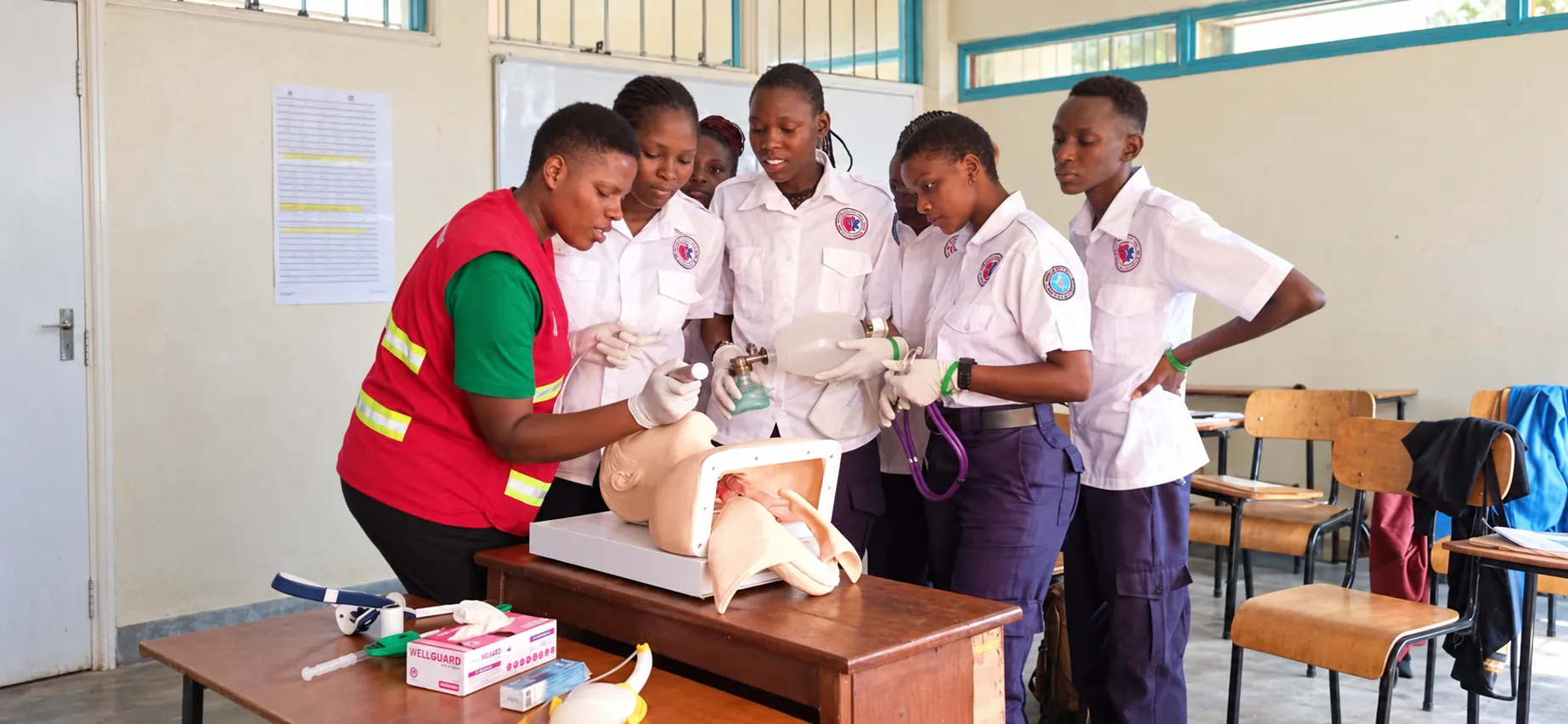
From today until Friday, 19 to 23 October 2026, emergency care educators, regulators and ambulance services meet in Machakos for a national workshop on how Kenya trains its Emergency Medical Technicians (EMTs) and Emergency Vehicle Operators. The Ministry of Health, through the Kenya National Public Health Institute (KNPHI) and with support from Malteser International, is consolidating a national curriculum for both cadres. Sahara EMS College is represented by our Head of Training, Julius Oigo Nyandieka.
To support the discussion, we have prepared a background brief for participants: Training Emergency Medical Technicians. A team of emergency care practitioners and educators combined its experience of running ambulance services and EMS training in Africa, Europe and the Middle East with a review of curricula, regulations and research from across Africa and around the world. The brief does not promote any single curriculum proposal. You can download it free of charge at the end of this article.
Why this matters now
Kenya's emergency care system is taking shape faster than ever. On 5 August 2026 the 922 emergency number and the National Ambulance Dispatch Centre went live. They serve all 47 counties and link more than 600 public and private ambulances. Since September 2025, the Kenya Medical Practitioners and Dentists Council (KMPDC) has required ambulances and emergency care personnel to register. And the Social Health Authority (SHA) now pays for ambulance care only when the national centre coordinates the dispatch, and only with a dispatch ID, run sheet, patient care record and signed handover.
What Kenya does not yet have is a common standard for how the people on those ambulances are trained. KMPDC's registration form lists Ambulance Operator, Emergency Medicine Technician and Paramedic, but sets no minimum qualification, scope or hours for any of them. Programmes leading to EMT qualifications currently range from six months of tuition to three years. Employers, SHA and patients cannot yet tell what an EMT certificate guarantees. That is exactly what a national curriculum can fix.
Seven things to know before the workshop
- The system is being built now. Dispatch, registration and payment rules are in place. A common training standard is the missing piece.
- Nobody in Africa has a ready-made answer. Levels, lengths and regulators differ from country to country, and the World Bank calls standardised accreditation of EMS training in sub-Saharan Africa “non-existent”.
- Length alone says little. Programmes of about one year list roughly 1,200 to 1,800 hours. What matters is what graduates can safely do, and how that is checked.
- The order of decisions matters. First the scope of practice, then competencies, content, hours and assessment.
- Practice, not lectures. Every skill must be practised hands-on: in a skills lab, then in simulation, then with real patients.
- Reforms fail on people, not on hours. Problems arise when entry levels rise without a bridge for staff already working.
- Good building blocks exist. WHO's 2025 prehospital guidance, the WHO-ICRC Basic Emergency Care course and a published disaster training design from Sierra Leone can be used. Their licences decide how.
What the rest of Africa shows
The countries that have made progress share one pattern: they defined levels and the scope of practice first, and wrote curricula afterwards.
- Tanzania fixed the scope of practice before writing its EMS courses. After the pilot, the practical share of its basic ambulance course rose to 60%. With no ambulance service to ride with, placements ran in the emergency department and the maternity ward.
- South Africa replaced its short courses between 2017 and 2020 with three higher-education levels: a one-year Higher Certificate, a two-year Diploma and a four-year Bachelor, each with its own professional register.
- Ghana's National Ambulance Service trains Basic EMTs in one year and Advanced EMTs in two years at its own school.
- Uganda now has two formal levels: a two-year Certificate in Emergency and Accidents Care, piloted from 2022, and a National Diploma in Medical Emergency Care.
How long, and how practical?
Internationally, programmes of about one year list roughly 1,200 to 1,800 hours, some of them including self-study. Three-year programmes list about 3,400 to 5,400 hours. The share spent with real patients in hospitals and on ambulances ranges from about a quarter to 70%: 37% for Estonia's EMT, 58% for Germany's three-year Notfallsanitäter and about 71% for Ontario's advanced care paramedic. Clear minimums can be checked: California, for example, requires at least 160 hospital hours and 480 ambulance hours for paramedic students.
Telling is not training
Medical skills cannot be learned by listening or watching alone. Every skill in an EMT curriculum needs hands-on practice with feedback: first in the skills lab, then in simulation, then with real patients under supervision. The brief describes what a skills lab needs, how simulation works on a small budget (students as patients with make-up wounds, a smartphone on a tripod, a structured debriefing) and how competence is checked fairly through practical OSCE stations, a signed logbook and a final examination set independently of the training institution.
It also looks at how training is organised. Many health programmes still teach subject by subject: anatomy first, diseases later, practice at the end. Vocational systems increasingly build training around real work situations instead, so-called learning fields or competency units. Kenya's TVET system already follows competency-based education and training.
Telling is not training. A programme that only describes skills does not produce competent EMTs.
At our campuses in Nakuru and Kisumu we train with medical simulation, audio-video debriefing and video laryngoscopy. We see every day that simulation complements real patients but cannot replace them. Both belong in a national standard: learning built around the situations EMTs actually face, and a substantial, clearly specified share of supervised time with real patients.
Reforms fail on people, not on hours
South Africa is the best-documented case. When its short courses were discontinued in 2017, 93% of the workforce held the two lowest short-course qualifications. In one district, only 0.9% of short-course staff met the entry requirements of the new Higher Certificate. Germany took a different route: experienced staff moved into the new Notfallsanitäter qualification through a supplementary exam, after a bridging course of 480 or 960 hours where needed, within a ten-year window.
The brief draws five lessons for Kenya:
- Regulator first. Levels, titles and scope should be defined with KMPDC before programmes are accredited.
- A published scope of practice before the first cohort graduates under the new curriculum.
- Recognition of prior learning and bridging modules for everyone already working, including maths and science where needed.
- Transition windows of several years, so services keep running.
- Accredit before enrolling, and protect students if accreditation is withdrawn.
Twelve questions to ask of any EMT curriculum
The brief closes with twelve questions that can be used to review any proposal, including the national draft. A good curriculum gives a clear answer to each.
- Is the scope of practice written down?
- Does each level match a KMPDC category?
- Does it fit the Kenya National Qualifications Framework?
- Are learning outcomes observable?
- Does Kenya's burden of disease set the weight?
- Is every intervention justified by evidence?
- Does it work with the equipment that is really there?
- How many hours are spent with real patients?
- Is every skill practised hands-on?
- How is competence checked?
- What happens to people already working?
- Are placements and preceptors available?
Our view
Sahara EMS College supports one national standard for EMT training. Since 2020 we have trained emergency care providers at our campuses in Nakuru and Kisumu, today more than 500 course participants a year. From that experience we believe the order of decisions matters: scope of practice first, then competencies, content, hours and assessment. A national curriculum should be built around the situations EMTs actually face, with every skill practised hands-on and a substantial, specified share of time with real patients. And the people already working on Kenya's ambulances need a clear and fair path into the new system.
Julius brings these points to Machakos this week. We will report on the outcome here on our Newsblog.
Download the background brief
The full brief has 18 pages, ten chapters and links to all 107 sources. It covers EMS basics, how a curriculum works, Kenya today, the African experience, international hour comparisons, ready-made building blocks and their licences, lessons from reforms, the twelve questions and a glossary of key terms. It is free to read and share.
Sources: Sahara EMS College, Training Emergency Medical Technicians, background brief, October 2026 · Citizen Digital (2026): 922 emergency response system · KMPDC: application for authority to practice as EMS personnel · SHA (2026): ambulance and emergency transfer tariffs · World Bank (2021): The State of Emergency Medical Services in Sub-Saharan Africa · WHO (2025): Prehospital emergency care, operational guidance · Sawe et al. (2019) · NECET (2017) · NotSan-APrV · Malteser International: improving EMS in Kenya and Uganda