
Picture a typical resuscitation today: an elderly man has collapsed in a narrow room at home, a bed and a cupboard in the way, a crowd at the door, relatives shouting, a phone line to the hospital that keeps dropping. Within minutes it is clear that the airway will be difficult and that this patient does not look like the manikin from training.
That scene does not happen in many training rooms. What happens there is often the same exercise as ten years ago: one adult manikin on the floor, thirty compressions, two breaths, a pat on the shoulder. Better than nothing — but no longer enough.
Six dimensions of a modern training room
1. Different bodies
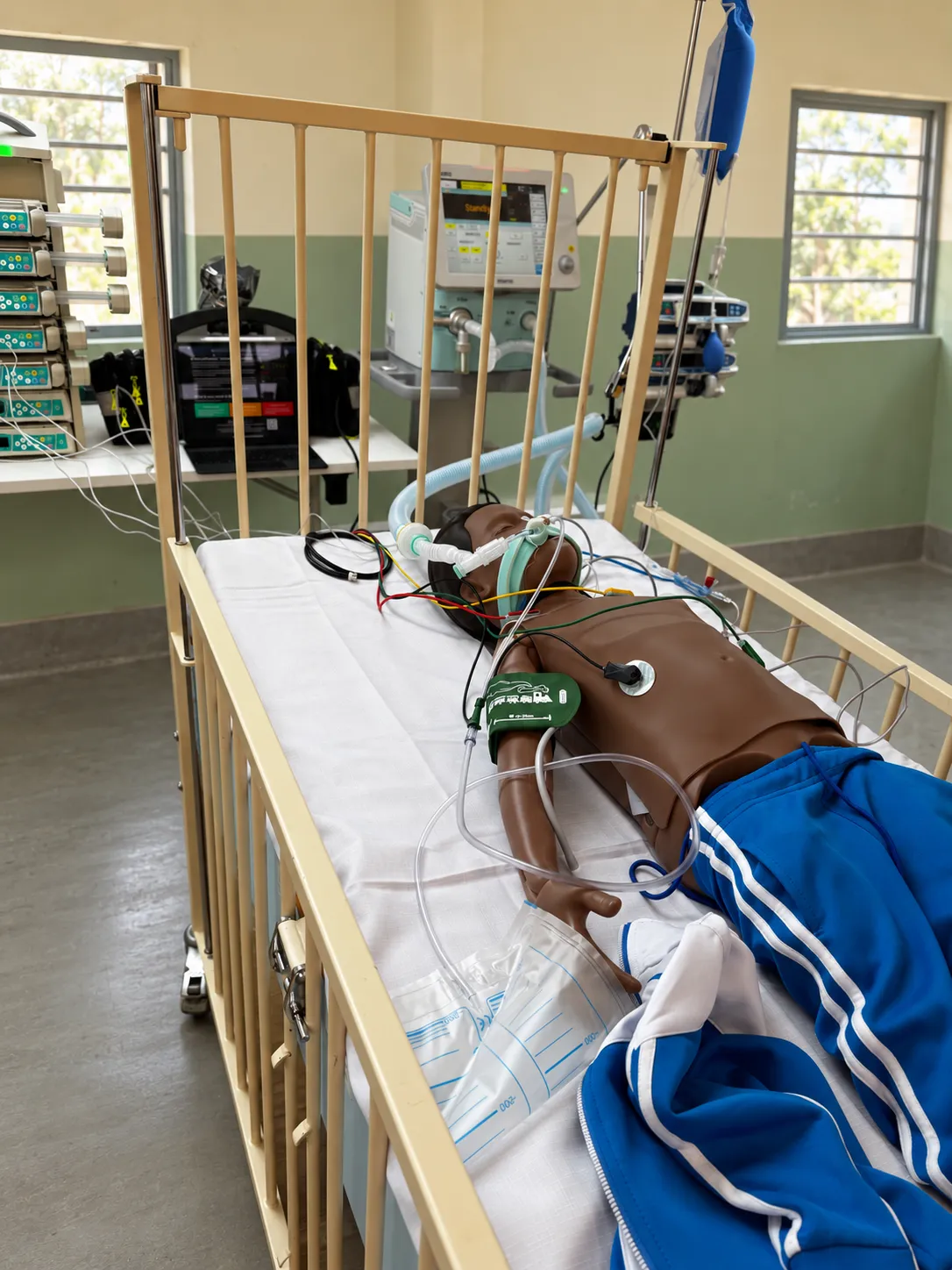
No patient is “standard”. A training pool needs infant and child manikins, adults of different builds, female and male anatomy — and in Kenya obstetric and newborn models, because emergency deliveries and newborn resuscitation are everyday EMS work. Simple additions change a scenario instantly: a silicone face mask alters mask fit, a fake beard creates a real ventilation challenge, a chest overlay changes pad placement. Our curriculum partner RESQPool Academy has used these tricks for years, at very low cost.
2. Different environments
Resuscitation rarely happens on a training table. It happens in a single room, in a matatu, beside a highway, in a market, on a construction site or in the back of a moving ambulance. Even without a dedicated simulation centre, desks, curtains and a stretcher can recreate tight spaces — and the ambulance in the yard is the best simulator there is.
3. Real-time feedback
Modern manikins measure compression rate, depth, recoil and ventilation volume live. The 2025 AHA Guidelines recommend feedback devices for CPR training, because visual assessment alone is unreliable — even for experienced instructors.
4. Team choreography
Resuscitation is a team sport. Who compresses, who ventilates, who leads, who talks to the relatives and to the receiving facility? The 2025 AHA Guidelines call for a specific emphasis on teamwork in life-support training. Closed-loop communication and clear roles have to be drilled, not assumed.
5. Debriefing — ideally with video
The biggest learning happens after the scenario, in a structured debrief. With audio and video recording, teams see their own choreography: tasks done twice, silent gaps, unclear leadership. Frameworks such as PEARLS make debriefing a learnable skill. A pilot in Kisumu showed that paediatricians trained virtually in simulation and debriefing measurably improved their debriefing.
6. Advanced skills
Video laryngoscopy, mechanical CPR devices and telemedicine consultations are reaching East African hospitals and ambulances. Training has to include them before they appear on a real call.
Equipment without good debriefing is only half as effective.
Simulation does not have to be expensive
Research from across the region is encouraging. A pilot in Burundi ran interdisciplinary emergency simulation with little more than a manikin and a tablet displaying vital signs. A team in Uganda converted a vacant room into a simulation lab for around US$5,000. A review of 47 studies on emergency obstetric simulation in sub-Saharan and Central Africa found positive effects at every level of training evaluation. The real bottleneck is usually not equipment, but trained facilitators who can design scenarios and lead good debriefings.
Four steps for training providers and services
- Take stock: which manikins, which feedback devices, which spaces and which recording equipment do you actually have?
- Map your curriculum against the six dimensions: a module that covers only one is not wrong, but it is incomplete.
- Invest in facilitators: debriefing is a skill, and equipment without it delivers only half its value.
- Document competencies, not just hours: which scenarios, which body types, which environments, with which feedback.
Our position
In our AHA ACLS and AHA PALS courses, every megacode runs in our simulation setting, is recorded on audio and video and is debriefed straight afterwards. AHA BLS is taught on feedback manikins, and paediatric scenarios run on dedicated paediatric simulation manikins. Our scenario lab in Nakuru recently added two stretchers so that teams can run patient-handling and transport drills in parallel. Recordings are used only for the debriefing and deleted afterwards.
Sources: AHA 2025 Guidelines for CPR and ECC, Resuscitation Education Science · Eppich & Cheng, PEARLS debriefing framework, Simul Healthc 2015 · Fant et al., virtual faculty development in simulation for paediatricians in Kisumu, Front Pediatr 2022 · Pilot simulation training on closed-loop communication in an emergency centre in Burundi (2025) · Feasibility of simulation-based medical education in a low-income setting, Uganda (Simul Healthc) · Scoping review of simulation-based emergency obstetric training in sub-Saharan and Central Africa · Healthcare simulation and primary care training curricula in Africa (2026)