
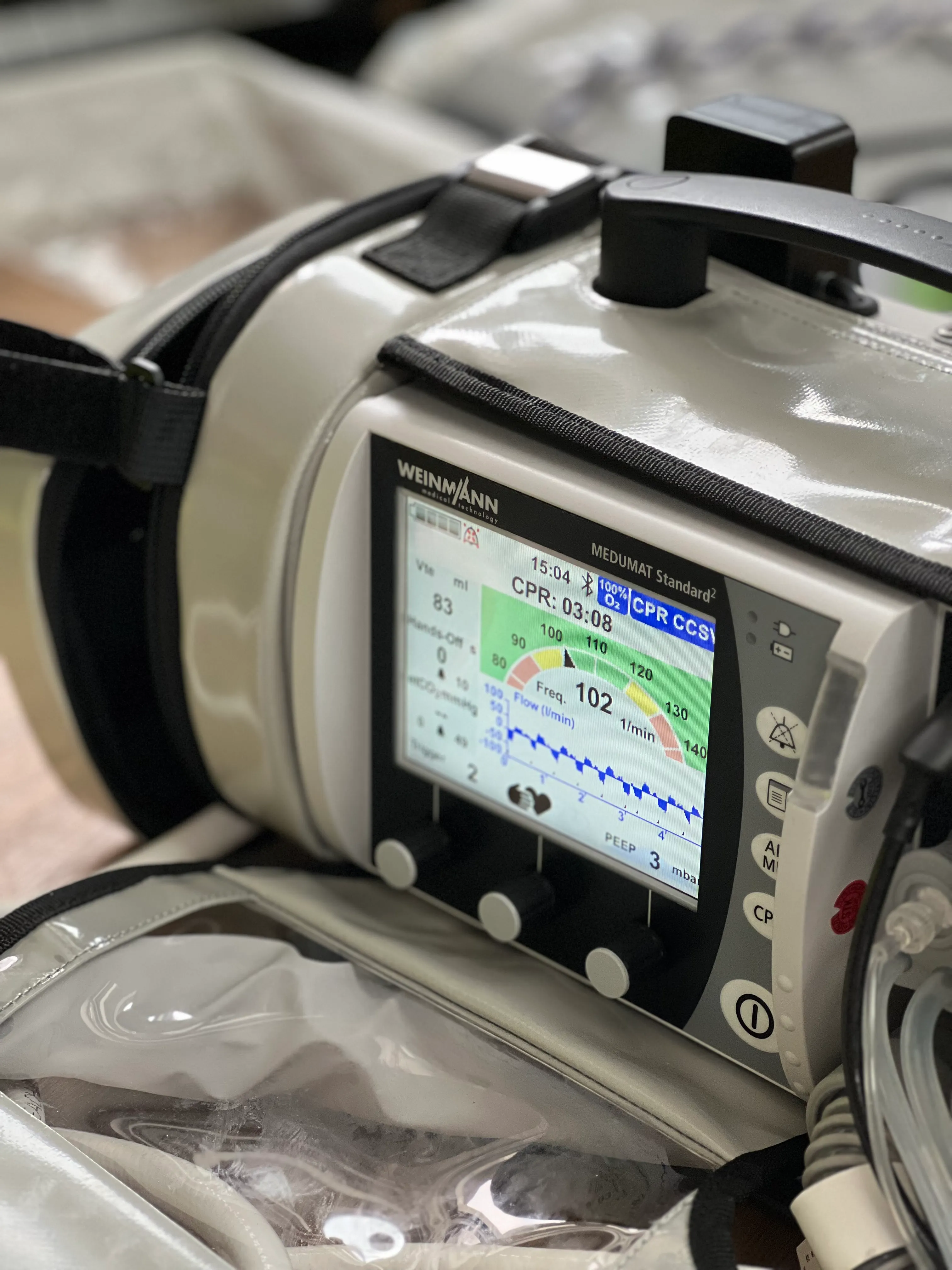
Ventilation is one of the least standardised parts of resuscitation. Compressions have clear targets for rate and depth; defibrillation has defined energies. For ventilation, the 2025 AHA Guidelines ask for enough volume to make the chest rise, warn against both too little and too much ventilation and — once an advanced airway is in place — recommend one breath every six seconds. The 2025 European (ERC) guidelines go one step further and, for the first time, give starting settings for ventilators during CPR: a volume-controlled or pressure-regulated mode, 6–8 ml/kg ideal body weight, 10 breaths per minute. At the same time they state clearly that the evidence is not strong enough to recommend any specific ventilation mode.
Three well-documented problems
1. Hyperventilation is the norm, not the exception
Since the landmark work of Aufderheide and colleagues (Circulation 2004) we know that professional rescuers using a bag-valve-mask often deliver around 30 breaths per minute instead of 10. Every breath raises the pressure in the chest, reduces the blood returning to the heart and lowers coronary perfusion. In their animal model, survival dropped from six of seven animals to one of seven at high ventilation rates. The problem persists — and a new randomised trial (OPTIVO) has been registered precisely because the optimal ventilation strategy during cardiac arrest is still unknown.
2. Ventilators struggle with compressions
Standard ventilators running during ongoing chest compressions mis-trigger, miss their volume or pressure targets and deliver tidal volumes that differ widely from what is set.
3. Timing works against us
Air delivered at the same moment as a compression partly escapes uselessly. During the release phase, when the lungs could refill, conventional ventilation is often in its expiratory phase.
The CCSV idea: synchronise instead of fighting
Chest Compression Synchronized Ventilation (CCSV), developed in Marburg, Germany, and available in a WEINMANN emergency ventilator, reverses the logic: every chest compression triggers a short pressure-controlled breath (40 or optionally 60 mbar, about 0.2 seconds). The release phase stays free of ventilation pressure, so venous return is not disturbed. This deliberately departs from the ERC starting settings described above.
What the evidence shows — and what it does not
- Animal studies consistently show better oxygenation and CO₂ removal with CCSV. A 2025 Finnish study during 35 minutes of CPR, however, also found clearly more pneumothoraces (12 vs 3 animals) — a reminder that high peak pressures are not trivial.
- A small randomised trial from Korea (Oh et al., J Clin Med 2025, 15 vs 15 patients) found a larger rise in oxygen levels under CCSV, but no statistically significant advantage — and, notably, fewer patients regained a pulse under CCSV than under conventional ventilation (47% vs 87%, not statistically significant).
- The largest human study (SYMEVECA, Madrid, 521 patients, not randomised) reported good neurological recovery in 16% with CCSV, 12% with conventional ventilator settings and 9% with a bag — a difference that was not significant overall. A 2026 follow-up analysis found better oxygenation 24 hours after admission and no increase in pneumothoraces with CCSV, but could only assess patients who reached hospital.
- Children: two 2026 piglet trials — one neonatal, one paediatric — found no faster return of circulation and no better survival with CCSV, but also no additional lung injury.
- Next: a prehospital randomised study from Vienna finished in March 2026; its results are still awaited.
In short: CCSV is physiologically plausible and improves surrogate markers. What is missing are adequately powered randomised trials showing better survival with good neurological outcome.
What this means for East Africa
In much of East Africa, ventilation during CPR is delivered with a bag-valve-mask squeezed by a tired rescuer — often the same person who has just carried the patient. The CCSV debate is therefore less about a specific device than about the problem it addresses: ventilation that is too fast, too forceful and badly timed. That problem can be tackled without any ventilator:
- Count, or use a metronome or timer: 30:2 without an advanced airway, one breath every six seconds with one.
- Give only enough volume for visible chest rise — not a full squeeze of the adult bag.
- Use waveform capnography wherever it is available to monitor ventilation and CPR quality.
- Rotate roles: the person ventilating should focus on that task alone.
Where services invest in transport ventilators, the 2025 ERC starting settings are a sensible default. Modes like CCSV deserve a serious look — but as a deliberate, locally approved choice, with proper training and with awareness of the open safety questions.
Our position
In our AHA ACLS courses and the Airway + Breathing Masterclass we treat ventilation quality as seriously as compression quality. We teach the fundamentals first — rate, volume, timing, capnography — because they apply in every ambulance, with or without a ventilator. We follow the ongoing CCSV research closely and will update our teaching as the evidence develops.
This article summarises the published evidence on ventilation during CPR as of October 2026. Clinical decisions must follow current AHA guidelines, local protocols and the individual patient’s situation.
Sources: AHA 2025 Guidelines for CPR and ECC, Adult Basic and Advanced Life Support · Soar J. et al., ERC Guidelines 2025 Adult Advanced Life Support, Resuscitation 2025;215 Suppl 1:110769 · Aufderheide et al., Circulation 2004 · Kill et al., Crit Care Med 2014 · Oh et al., J Clin Med 2025;14(7):2394 · Kopra et al., Resuscitation Plus 2025;22:100918 · Hernández-Tejedor et al. (SYMEVECA phase 2), Resuscitation 2025;213:110655 · Hernández-Tejedor et al., SYMEVECA sub-analysis, Emergencias 2026;38:195–199 · Paediatric and neonatal piglet trials, Pediatr Res 2026 and Intensive Care Med Exp 2026 · Vienna CCSV study, NCT06836908 · OPTIVO trial, NCT07479836