
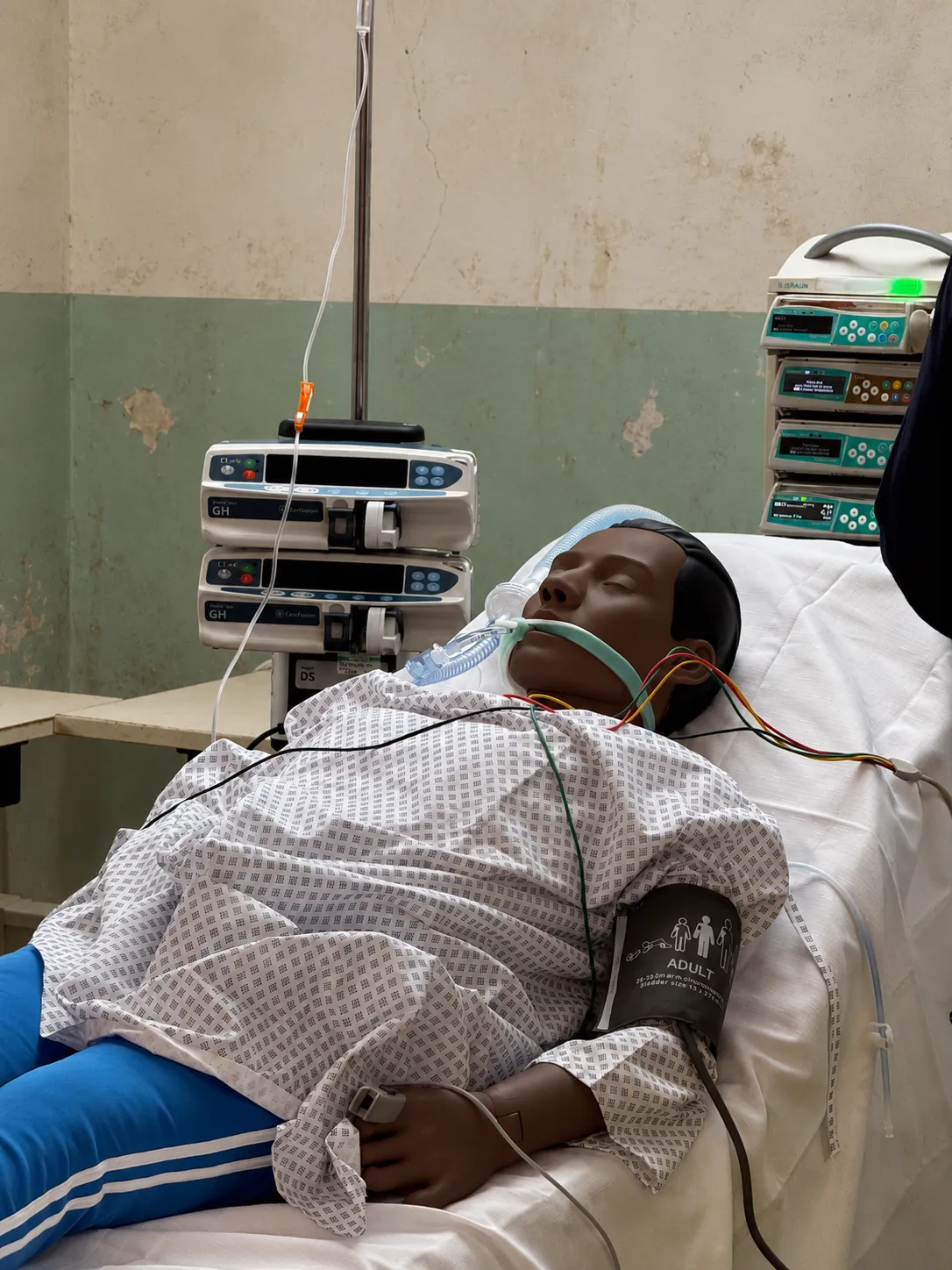
A 78-year-old woman in Nakuru, “just not herself” for two days. She is drinking less and fell once this morning — no injury, no loss of consciousness. Her vital signs are unremarkable. Her daughter brings a plastic bag full of medicines: two for blood pressure, one for diabetes, a diuretic, painkillers bought at the chemist and a herbal remedy. The EMT runs through the algorithms in his head. None of them fits.
Situations like this are not the exception. They are a large part of everyday emergency care — and exactly what algorithm-based training covers least.
What algorithms do well
Algorithms are powerful where the picture is clear and time-critical: cardiac arrest, anaphylaxis, severe hypoglycaemia, major trauma. They reduce variation, protect patients and providers, and allow less experienced staff to act safely. That is why AHA courses, PHTLS and national treatment guidelines are built on them — and why we teach them with conviction.
Where algorithms do not reach
Kenya faces what researchers call a “triple burden”: injuries, non-communicable diseases such as hypertension and diabetes, and communicable diseases together with maternal and newborn conditions — all at the same time, often in the same patient. An older patient on long-term HIV treatment with hypertension and a new infection rarely presents with a textbook symptom. Weakness, confusion, a fall, “not herself”: no single algorithm starts there.
Even trauma, which algorithms handle best, has blind spots. A 2024 study of road-crash victims in Nakuru County found that bystanders, not professionals, were the first to respond in about two out of three cases, and only a small minority reached hospital by ambulance. When EMTs do arrive, they often find patients who have already been moved, treated or transported in ways no algorithm anticipates.
The answer is not fewer algorithms. It is more reasoning alongside them.
What cognitive science says
- Heuristics and biases (Kahneman, Tversky, Croskerry): fast, intuitive decisions are distorted by predictable errors — anchoring on the first idea, premature closure, “it’s just the usual”. Most diagnostic errors in emergency medicine are cognitive, not gaps in knowledge.
- Naturalistic decision making (Klein): experts recognise patterns and mentally simulate what will happen next. Algorithms are, in effect, codified pattern recognition for typical cases.
- From novice to expert (Benner): beginners need rules; experts use them as a structure for unclear situations, not as a script.
What other countries do differently
The UK, Canada, Australia and Sweden have moved paramedicine from a mainly procedural to a clinical-diagnostic profession: university-level education, specialisation paths in critical care or community and geriatric care, and structured clinical reasoning as a core subject. Community paramedics visit chronically ill patients at home and coordinate with primary care — a model with obvious relevance for counties where the nearest doctor may be hours away.
Five building blocks for Kenya
- Clinical reasoning as a subject: differential diagnosis, cognitive biases and structured thinking — taught and assessed, not left to chance.
- “Low-code” simulation: scenarios without a clear algorithm entry — the confused elderly patient, the unclear abdominal pain, the decision whether to transport at all.
- Context-specific content: maternal emergencies, HIV and TB as co-morbidities, hypertensive and diabetic emergencies, medicines taken without prescription.
- Diverse placements: not only casualty and theatre, but maternity, medical wards and primary care facilities.
- Reflective quality systems: case reviews and feedback loops, so that algorithms remain a living tool rather than a rigid routine.
Our position
We teach algorithms with conviction — they save lives. But in our EMT programme, patient assessment comes before any algorithm, and we want our graduates to know not only how to follow an algorithm, but when and why to depart from it, based on structured thinking rather than gut feeling. Our ECG Basic course follows the same idea: turning a rhythm strip into a clinical decision, not just a label.
Sources: Retrospective review of patient cases at Kenyatta National Hospital and implications for emergency care development (“triple burden”, 2019) · Determinants of adequate prehospital trauma care among road traffic crash victims, Nakuru County, Kenya (2024) · Croskerry P., dual-process theory and cognitive bias in emergency medicine · Kahneman D., Tversky A., heuristics and biases · Klein G., Recognition-Primed Decision model · Benner P., From Novice to Expert (1984) · Shannon B. et al., international consensus definition of community paramedicine, Paramedicine 2023