
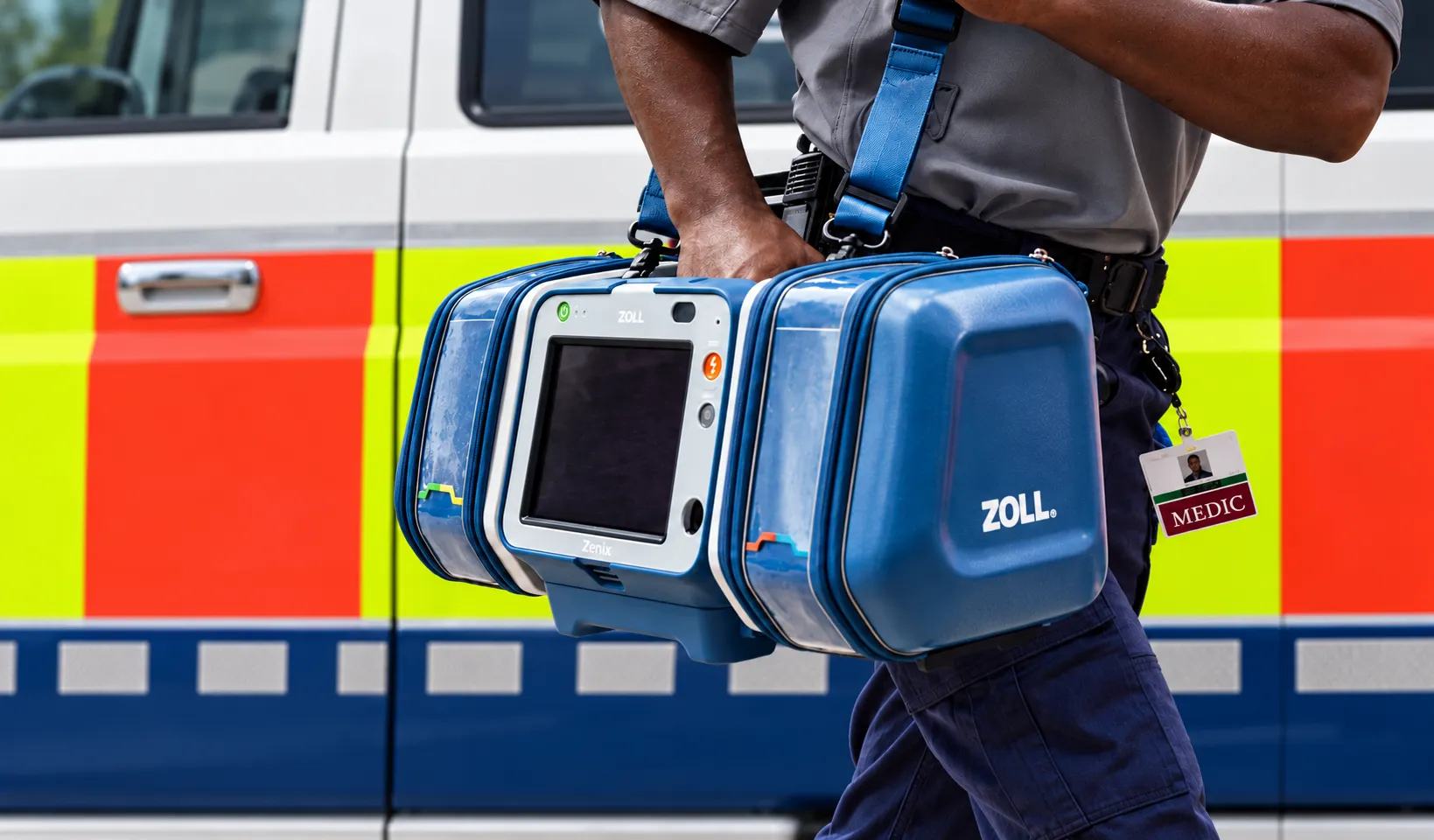
In autumn 2025 the US Food and Drug Administration approved the Zoll Zenix, a new professional monitor-defibrillator. In February 2026 it received approval under the EU Medical Device Regulation and is now being presented to ambulance services in Europe. It will be a while before it appears in a Kenyan ambulance. But the ideas behind it — and the question of what really improves resuscitation — matter here today.
What is new
- Touch-first operation: a large touchscreen through which, according to the manufacturer, almost every function can be reached in three touches or fewer — while a physical rotary knob remains for gloves, vibration and wet hands.
- Real CPR Help: sensors in the pads measure compression depth and rate and give live feedback; filtering can show the underlying rhythm during compressions.
- Real BVM Help: a sensor on the bag measures ventilation volume and rate and shows the person squeezing the bag whether they are on target.
- Paediatric automation: when paediatric pads are connected, energy levels, alarm limits and feedback targets switch automatically.
Most of these functions are not entirely new. What is new is that they come as standard rather than as options, and that the device is designed around feedback rather than buttons.
Why feedback matters
Visual assessment of CPR quality is unreliable — even experienced instructors misjudge depth and rate. That is why the 2025 AHA Guidelines recommend feedback devices in CPR training for health professionals and lay rescuers alike, and earlier AHA guidance already considered real-time feedback during actual resuscitation reasonable. For ventilation, simulation and manikin studies have shown that live feedback brings rate and volume much closer to target — important, given how common hyperventilation is. The 2025 European (ERC) guidelines, however, still see insufficient evidence to recommend ventilation feedback devices routinely during real resuscitations, while calling it an evolving field. Training with feedback is established; using it on every real patient is not yet.
The Kenyan reality
Kenyan ambulance fleets are mixed: different brands and generations of monitors and AEDs, some new, many refurbished or donated, and plenty of ambulances with only an AED or no monitor at all. KMPDC’s registration of ambulances and the national ground ambulance standard (KS 2429) push towards minimum equipment, but for years to come EMTs will move between very different devices. Two consequences follow.
- Device familiarisation is a safety issue. An EMT who works on three different defibrillators in one month needs a structured orientation for each — not trial and error during a cardiac arrest.
- Feedback must not depend on the device. Where there is no built-in feedback, teams can create it themselves.
- A CPR coach whose only job is to watch compression rate, depth, pauses and ventilation and to call out corrections
- A metronome — many phones have one — set to around 110 per minute
- A ventilation timer: one breath every six seconds once an advanced airway is in place
- Waveform capnography where available — the best real-time indicator of CPR quality and tube position
Our position
We teach AHA BLS on feedback manikins, so participants see their real compression quality instead of guessing it, and our ECG Basic course works on a modern monitor-defibrillator, the corpuls3. Our message to EMTs is the same regardless of brand: know the device in front of you, and build a team that gives itself feedback when the device does not. New platforms like the Zenix show where the profession is heading. High-quality CPR in Kenya does not have to wait for them.
Device features are based on manufacturer information. Please verify them against current technical data before any procurement decision.
Sources: Zoll, announcements of FDA premarket approval (2025) and EU MDR approval (February 2026) · AHA 2025 Guidelines for CPR and ECC, Resuscitation Education Science · AHA 2020 Guidelines, real-time audiovisual feedback · ERC Guidelines 2025 Adult Basic Life Support (ventilation feedback devices) · Lyngby et al., ventilation feedback during CPR, Resuscitation Plus 2021 · Krammel et al., Real BVM Help before-after manikin study, Open Access Emerg Med 2025 · KMPDC public notice on the registration of ambulances (2025) · Ministry of Health, Kenya Emergency Medical Care Policy 2020–2030 (KS 2429:2019)