
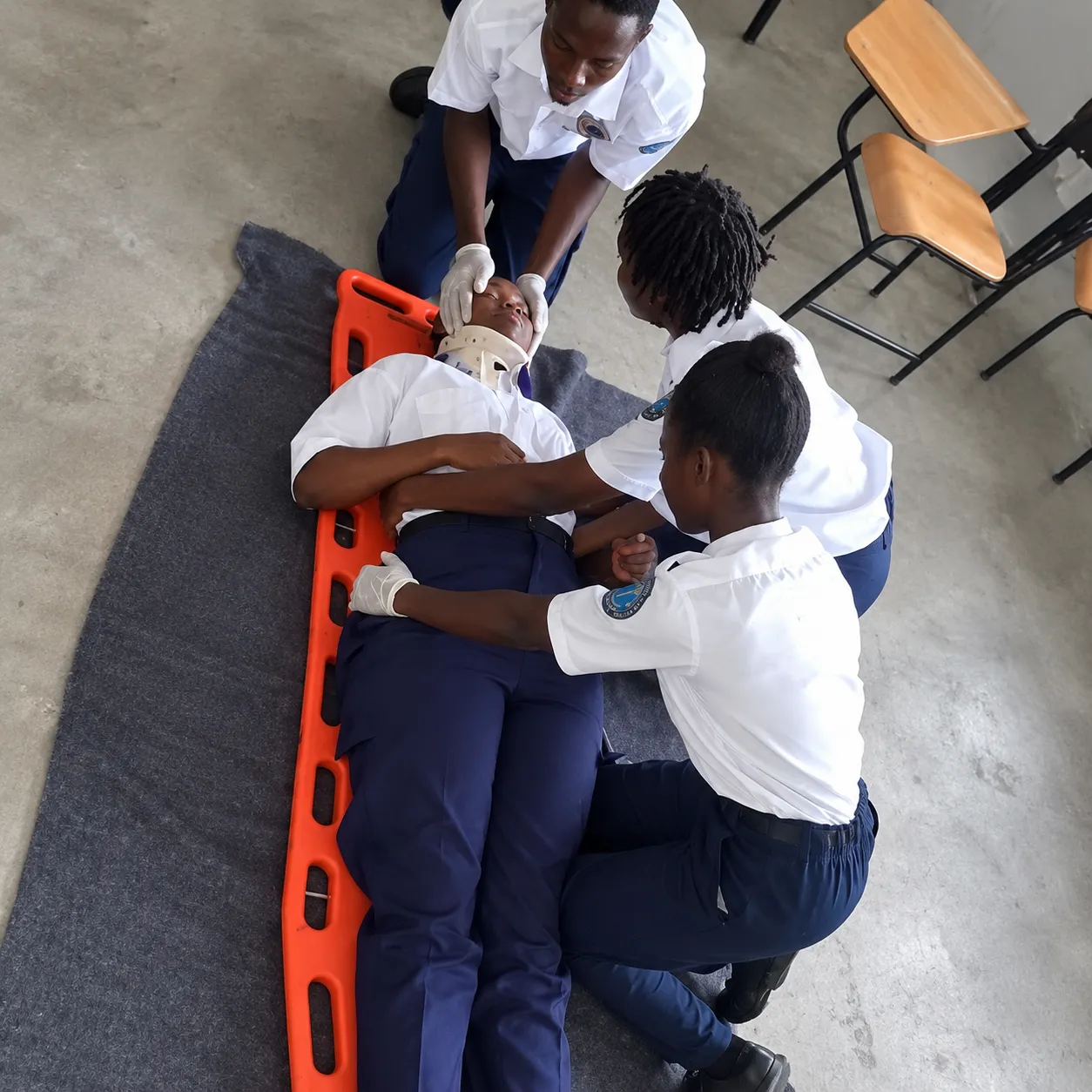
A 24-year-old boda-boda rider has come off his motorcycle on the Nakuru–Nairobi highway. Bystanders have already pulled him to the roadside. He is awake and talking, but he cannot move or feel his legs. His blood pressure is 84/50 mmHg, his pulse 56 per minute, and his skin is warm and dry. Is he in shock? And if so, which one?
Haemorrhagic, hypovolaemic, cardiogenic, obstructive, distributive, septic, anaphylactic, neurogenic — everyone in emergency care knows the list of shock types. One term often appears next to them and does not belong there at all: spinal shock. Despite its name, it has nothing to do with blood pressure. Mixing it up with neurogenic shock is a common mistake in spinal trauma — and the idea for this article comes from a colleague who made exactly that mistake and wrote about it (see sources).
Shock means something specific
In emergency medicine, shock means that the body's tissues do not receive enough oxygen for their needs. Whatever the cause — blood loss, a failing heart, a blocked circulation or wide-open blood vessels — the result at cell level is the same. Knowing the cause matters, because the treatment differs.
Spinal shock: a reflex problem, not a circulation problem
Spinal shock describes what happens to the nerves below a spinal cord injury: muscle tone and reflexes disappear or are strongly reduced. The patient has floppy (flaccid) paralysis and no tendon reflexes below the injury. The term goes back to the British physiologist Marshall Hall in the mid-19th century. In 2004, Ditunno and colleagues described four phases:
- Day 0–1: reflexes absent or strongly reduced.
- Day 1–3: the first reflexes return.
- Weeks 1–4: reflexes become stronger than normal (early hyperreflexia).
- Months 1–12: late hyperreflexia and spasticity.
Two points matter on scene. First, spinal shock tells you nothing reliable about the final outcome: current guidelines advise waiting about 72 hours before judging how severe a spinal cord injury will be. Some patients — for example after a spinal cord “concussion” — recover completely within three days. Second, findings change. A patient who could not move his legs at the roadside may move them in the emergency department, or the other way round. That does not mean that someone examined badly. It is the reason we examine early, write down the time, and repeat the examination.
Neurogenic shock: a real shock
Neurogenic shock is a circulation problem. The nerves of the sympathetic system — the “fight or flight” system that keeps blood vessels tight and the heart rate up — leave the spinal cord in the neck and upper chest region. An injury to the cervical or upper thoracic spinal cord, usually at T6 or above, can cut them off. Two things follow:
- the blood vessels below the injury relax and widen, blood pools and the blood pressure falls — a form of distributive shock;
- the vagus nerve, which slows the heart, now works unopposed — the heart rate falls, or at least does not rise.
Typical signs are low blood pressure with a slow or normal pulse, warm, dry, often flushed skin below the injury, and sometimes priapism in men. Patients also lose much of their ability to control their body temperature and cool down quickly. With injuries at C3–C5, breathing is at risk too, because these segments supply the diaphragm. Watch for abdominal or paradoxical breathing — the belly moves out while the chest does not — a weak cough and a patient who is tiring.
How often does it occur? That depends on the definition used. A large UK registry study found neurogenic shock in about one in five patients with an isolated cervical spinal cord injury (19%), and in far fewer with thoracic or lumbar injuries. A 2018 cohort study found 29% in cervical injuries when laboratory values were included in the definition. A UK study showed that most cases became apparent within two hours of injury — often while the patient is still with the ambulance crew — and that a few occurred even with injuries below T6. Neurogenic shock can last days to weeks.
Three conditions, side by side
- Spinal shock: loss of reflexes and muscle tone below the injury. Not a circulation problem; the blood pressure can be normal.
- Neurogenic shock: low blood pressure, slow or normal pulse, warm and dry skin. A circulation problem caused by the spinal cord injury.
- Haemorrhagic shock: low blood pressure, fast pulse, cold, pale and sweaty skin, fast breathing, anxiety or confusion. A circulation problem caused by blood loss.
One patient can have all three at the same time.
The trap: bleeding comes first
Back to our rider. His slow pulse and warm skin point towards neurogenic shock — and that is exactly where the danger lies. The ATLS manual for trauma care teaches that a patient with a spinal cord injury and low blood pressure is treated as having haemorrhagic shock unless another cause is clearly evident. Neurogenic shock is a diagnosis of exclusion, for good reasons:
- Many patients with a spinal cord injury also have injuries to the chest, abdomen, pelvis or limbs.
- A patient who cannot feel below the injury cannot tell you that his abdomen or pelvis hurts.
- Neurogenic shock removes the fast pulse that would normally warn you of bleeding. Beta-blockers, pacemakers, old age and athletic fitness can hide it as well.
So look actively for bleeding: chest, abdomen, pelvis, long bones — and the ground around the patient. Hidden bleeding kills faster than neurogenic shock.
Not to be confused with Cushing
A slow pulse after trauma also occurs with severe head injury. The Cushing reflex — rising blood pressure, slow pulse and irregular breathing — is a late sign of dangerously raised pressure inside the skull. The difference: in neurogenic shock the blood pressure falls; with the Cushing reflex it rises. Both are emergencies, with very different meanings.
What EMTs do on scene
- Catastrophic bleeding: stop it first — direct pressure, wound packing, tourniquet.
- Airway: open it with a jaw thrust while a second person holds the head in line by hand (manual in-line stabilisation). Suction early.
- Breathing: look for paradoxical or weak breathing. Give oxygen if the saturation is low, aiming for about 94–98%, and assist ventilation with a bag-valve-mask if breathing is inadequate.
- Circulation: search for sources of bleeding, check pulse, skin and blood pressure, and prevent low blood pressure — a systolic pressure below 90 mmHg damages the injured spinal cord further. Where IV access and fluids are within your scope and protocols, give fluids carefully. Vasopressors such as noradrenaline, and atropine for a very slow heart rate, are advanced or hospital treatments — call for them early.
- Disability: check movement and feeling in all four limbs before moving the patient, write down what you found and when, and repeat it during transport.
- Exposure and environment: keep the patient warm — blankets, heating in the ambulance, nothing wet.
- Spinal motion restriction, not blind immobilisation: according to the 2018 joint position statement of US trauma surgeons, emergency physicians and EMS physicians, endorsed by NAEMT, spinal motion restriction is indicated after blunt trauma with reduced consciousness or intoxication, midline neck or back pain or tenderness, neurological deficits, a spinal deformity, or distracting injuries. Long boards, scoop stretchers and vacuum mattresses help to move the patient; the long board is a tool for extrication and transfer, not a bed for the journey. In penetrating trauma, spinal motion restriction has no role.
- Destination and handover: take the patient to a hospital that can treat spinal injuries — not simply the nearest one — alert it in advance, and hand over your first neurological findings together with the time.
What happens in hospital — and why it matters to us
The injured spinal cord needs blood flow. US neurosurgical guidelines (AANS/CNS, 2013) recommend correcting a systolic pressure below 90 mmHg as soon as possible and keeping the mean arterial pressure (MAP) at 85–90 mmHg for the first seven days. A 2024 international guideline (AO Spine/Praxis) recommends keeping the MAP at least at 75–80 mmHg, without actively raising it above 90–95 mmHg, for three to seven days. Either way, every minute of low blood pressure before hospital counts against the patient — so preventing it starts with us.
Why this matters in Kenya
In Kenya, spinal cord injuries mostly affect young men. In a study from Kenyatta National Hospital, Coast General and Machakos Level 5 Hospital, road traffic crashes caused 45% of spinal cord injuries and falls from height 42%, and almost half of the injuries were cervical. NTSA counted 4,458 road deaths by early December 2025, among them 1,148 motorcyclists and 432 pillion passengers. And care often starts without professionals: in a 2024 study of road-crash victims in Nakuru County, bystanders were the first responders in about two out of three cases, and only 7% reached hospital by ambulance. Every EMT who can tell spinal shock, neurogenic shock and bleeding apart makes a real difference — and so does every first aider who knows not to lift an injured rider by the arms and legs.
Learn it hands-on: PHTLS in Nakuru
Spinal trauma, shock and spinal motion restriction are core topics of the Prehospital Trauma Life Support (PHTLS) course. Our next PHTLS provider course runs from Friday 20 to Sunday 22 November 2026 at our Nakuru campus, together with our partner Emergency Care Trainers Ltd (ECT), an authorised NAEMT training centre. The fee is KES 37,500 including the NAEMT provider card, and bookings close on 30 October. All details and booking →
Our position
Words shape decisions. “Spinal shock” describes reflexes; “neurogenic shock” describes circulation — and neither may distract from the search for bleeding. We teach our AEMT students to examine and document neurology early and repeatedly, to treat low blood pressure after trauma as bleeding until proven otherwise, and to protect the injured spinal cord by preventing hypoxia, hypotension and hypothermia.
Sources
Idea for this article
- Stanley M. Spinaler Schock, der Schock der kein Schock ist. dasFOAM, September 2023 (German).
Spinal shock and neurogenic shock
- Ditunno JF, Little JW, Tessler A, Burns AS. Spinal shock revisited: a four-phase model. Spinal Cord 2004;42:383–395.
- Mahanes D et al. Guidelines for neuroprognostication in adults with traumatic spinal cord injury. Neurocritical Care 2024;40:415–437.
- Zwimpfer TJ, Bernstein M. Spinal cord concussion. Journal of Neurosurgery 1990;72:894–900.
- Guly HR, Bouamra O, Lecky FE. Incidence of neurogenic shock in patients with isolated spinal cord injury in the emergency department. Resuscitation 2008.
- Ruiz IA et al. Incidence and natural progression of neurogenic shock after traumatic spinal cord injury. Journal of Neurotrauma 2018;35:461–466.
- Taylor MP, Wrenn P, O'Donnell AD. Presentation of neurogenic shock within the emergency department. Emergency Medicine Journal 2017;34:157–162.
Guidelines and position statements
- American College of Surgeons. Advanced Trauma Life Support (ATLS), Student Course Manual, 10th edition, 2018.
- Fischer PE et al. Spinal motion restriction in the trauma patient – a joint position statement. Prehospital Emergency Care 2018;22:659–661.
- Ryken TC et al. The acute cardiopulmonary management of patients with cervical spinal cord injuries. Neurosurgery 2013;72 Suppl 2:84–92.
- Kwon BK et al. AO Spine/Praxis recommendations on hemodynamic management in acute spinal cord injury. Global Spine Journal 2024;14(3 Suppl):187S–211S.
- Neurocritical Care Society. Emergency Neurological Life Support: Traumatic Spinal Cord Injury, version 6.0, 2024.
- ScotSTAR. CG033 Acute Spinal Cord Injury, 2023.
Kenya
- Muli GM et al. Spinal cord injuries at Kenyatta National Hospital, Coast General and Machakos hospitals, 2016–2020. South African Journal of Physiotherapy 2025;81(1):a2097.
- Kisaka Y et al. Determinants of adequate prehospital trauma care among road traffic crash victims, Nakuru County, Kenya, 2024. Conference abstract, TEPHINET.
- Citizen Digital. NTSA reports spike in road fatalities as 2025 death toll hits 4,458. December 2025.